
Washington County Arrest Records and Court Charges
A Washington County arrest record is the account of an arrest itself. It shows who was taken into custody, who made the arrest, and the booking that followed at the county jail. The Washington County Sheriff serves as the county jailor and keeps a jail docket of bookings. An arrest by itself does not file a charge. After the booking, a prosecutor reviews the facts and decides which charges, if any, to file with the court clerk. Those filed charges become the court charge record.
The two records sit on different sides of the same event. The arrest record lives on the booking and sheriff side. For the jail roster and booking detail, the Washington County inmate records page is the right place to start. The court charge record is what the prosecutor filed and tracked through the case. It lists each charge, its code, and its current status. The full case file, with pleas, hearings, and the final outcome, sits in the Washington County criminal court records. Court charges after arrest can change as a case moves, so the charge record is read next to the case file.
How to Find Washington County Arrest Records
Washington County does not run one public arrest-records search box. Court charges show up in Mississippi Electronic Courts, known as MEC, and its public viewing system, PAMEC. Circuit Court and County Court criminal files route through the Circuit Clerk. Remote viewing needs a PAMEC login. The clerk counter is the fallback when an online search comes up short. Booking detail itself lives in the jail docket, not the court portal.
- Open the MEC case search through PAMEC, or visit the Circuit Clerk's office in Greenville.
- Search by the defendant's name, or by case number when you have one.
- Open the matching case and read the list of filed charges.
- Check each charge for its code, its level, and its current status.
The earliest charge records often sit in the lower courts. Justice Court, at 905 W. Alexander Street in Greenville, holds the first records after many Washington County arrests, including the affidavits and initial appearances. Greenville Municipal Court handles city charges and traffic matters. For older or non-digitized files, the clerk who holds the case is the place to ask.
A statewide criminal-history file sits with the Mississippi Department of Public Safety. Its Criminal Information Center processes court dispositions, expunction orders, and criminal-history requests. That record gathers charges from courts across Mississippi, not just Washington County.
From Arrest to Initial Appearance in Washington County
An arrest in Washington County starts a fast clock. After booking, the arrested person is screened and routed to court for a first hearing. The county Justice Court judges hold sessions at the jail three times each week. These sessions protect each person's right to an initial appearance within three days of arrest. Justice Court is also where all felony cases are first heard for the initial appearance and the filing of the affidavit.
At the initial appearance, the judge reviews the charge, advises the person of their rights, and addresses bond. County Court judges may set bond and hold preliminary hearings. The charge named at this early stage can still change. It is the start of the court charge record, not the final word.
Note: An initial appearance confirms the charge and bond, but the prosecutor may later amend, add, or drop charges before the case reaches trial.
Who Files Washington County Charges
Two offices decide most Washington County charges. The County Prosecuting Attorney represents the state in felony matters before the Justice Court and the County Court. The same office handles criminal appeals from County Court to Circuit Court and can present matters to the grand jury. The Mississippi Delta District Attorney, the 4th District prosecutor, carries felony prosecutions into Circuit Court.
The county names its prosecuting attorney and office contact on the official Washington County County Prosecutor page.
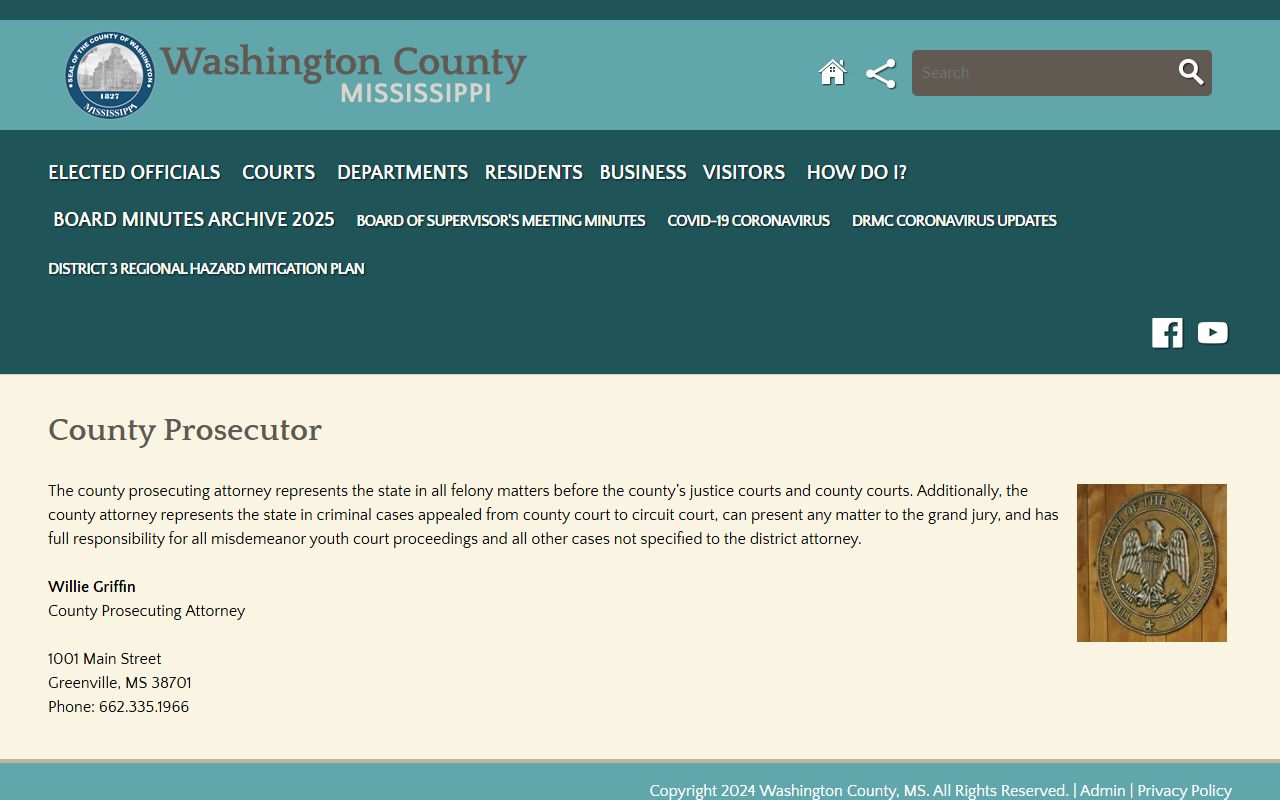
That office decides which charges to file after many local arrests and which to send to the grand jury. Felony charges in Mississippi can reach the court two ways. A prosecutor may file an information, or a grand jury may return an indictment. Misdemeanor charges often begin with a sworn affidavit or complaint in Justice Court. Each path opens a charge record the clerk keeps.
How Charges Get Filed After an Arrest: Complaint, Information, and Indictment
The charge record begins with a charging document. The arrest happens at booking. The formal charge starts when the prosecutor or a grand jury files the paper that names the offense. Three main types are used in Washington County and across Mississippi.
| Complaint | Information | Indictment | |
|---|---|---|---|
| Filed By | Officer / Prosecutor | Prosecutor | Grand Jury |
| Common For | Misdemeanors | Many felonies | Serious felonies |
| Starts | The case | The case | The case |
Charge Codes and Severity Levels
Each charge points to a statute. The charging document lists the code section the state says was broken. The code fixes the offense level too. Mississippi sorts crimes into felonies and misdemeanors. A felony carries the chance of a year or more in state custody. A misdemeanor carries lighter jail time or a fine. One arrest can produce several separate charges. A single booking might list one felony count and two misdemeanor counts. Each count gets its own code and its own status. Reading the code and the level tells you how serious the state treats each charge. In a Washington County file, the charge list is the quickest way to see what the arrest actually led to.
Charge Status in Washington County Cases
Charges are not fixed once filed. They shift as a case moves. A prosecutor may amend a charge, reduce it, add a count, or drop it. The charge record marks each change. Common status terms appear below.
| Status | What It Means |
|---|---|
| Pending | The charge is filed and open, with no final outcome yet. |
| Amended / Reduced | The charge was changed, often to a lesser offense or a different count. |
| Dismissed | The court ended the charge, so it is no longer prosecuted. |
| Nolle Prosequi | The prosecutor chose not to pursue the charge. |
Note: Nolle prosequi means the prosecutor dropped a charge, which is not the same as a court finding the person not guilty at trial.
Statewide and Federal Charge Lookups
Washington County charges roll up into larger systems. At the state level, the Mississippi Department of Public Safety keeps the central criminal-history file. Its Criminal Information Center handles wants and warrants, court dispositions, the sex offender registry, and expunction orders. A formal criminal-history request runs through that office, not the county clerk.
Some Delta arrests lead to federal charges handled by the U.S. Attorney's Office for the Northern District of Mississippi.
Federal charges sit in the federal court system, apart from Washington County Circuit and Justice Court files. A person arrested on a federal charge is booked and then routed to a federal court, not the local courthouse.
Charges vs. Convictions
A charge is an accusation. A conviction is the outcome. Being charged after an arrest does not mean a person was found guilty. The two stand at different points in the case and rest on different proof.
| Charge | Conviction | |
|---|---|---|
| Stage | Accusation | Verdict or plea |
| Burden of Proof | Probable cause | Beyond reasonable doubt |
| Public Record | Yes | Yes |
Federal Arrests and Charges in the Delta
Federal arrests sometimes sweep through the Mississippi Delta. When agents and federal prosecutors act, the charges land in federal court rather than the county courthouse. These cases still start with an arrest and a booking, then move to a federal charging document.
In one recent case, the U.S. Attorney's Office announced 20 arrests tied to an alleged Mississippi Delta drug-trafficking conspiracy.
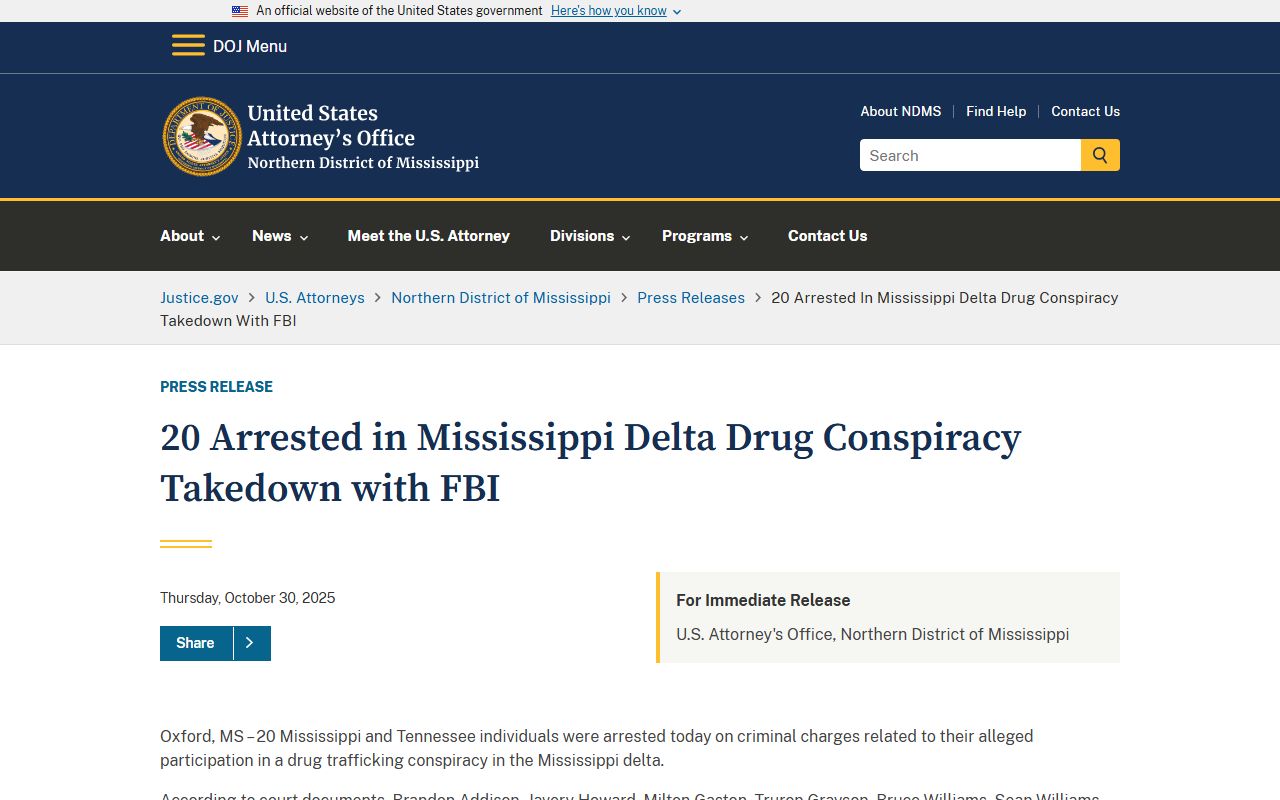
A large federal takedown like that one shows how an arrest can lead to charges filed far from the local Justice Court. The county clerk will not hold these federal files.
Sealed vs. Expunged Records in Washington County
Some arrest and charge records can be closed off. Mississippi lets eligible cases be expunged by petition. The 4th District Attorney's expungement page is the best local guide to who qualifies. Dismissed, dropped, not-guilty, certain misdemeanor, first-offense DUI, and some felony matters can qualify. Violent crimes and listed serious offenses are excluded.
| Sealed | Expunged | |
|---|---|---|
| Visibility | Hidden from public | Destroyed / treated as never existed |
| Law Enforcement | Limited access | Very limited |
| Eligibility | Set by statute or court order | Eligible cases under Miss. Code 99-19-71 or 99-15-26 |
Note: Expunction is not automatic in Mississippi, so a person must petition the court where the charge began and may owe filing and document fees.
Washington County Background Checks
A casual name search is not a background check. An employer, landlord, or lender that makes a decision must follow the federal Fair Credit Reporting Act. That law sets rules for how criminal records are gathered and used. A quick look at a court portal or a jail docket does not meet those rules. A regulated screening pulls verified records and gives the person a chance to respond.
Important: This site is not an FCRA-regulated consumer reporting agency, and its information must not be used for credit, employment, tenant, or insurance decisions.
Restricted Charge Records in Washington County
Not every Washington County charge record is open. Youth Court records are confidential under Mississippi law and stay closed to the public. Sealed and expunged charges are removed from public view. Some dismissed charges may be withheld once a case closes. Charges tied to an open investigation may not appear until the case is filed. When a search comes up empty, the record may be restricted rather than missing. Call the Circuit Clerk or the Chancery Clerk to confirm where a file sits and whether any part is public.
A written public-records request is the formal route when a Washington County charge record is not online. The Mississippi Public Records Act is the legal backstop. Direct the request to the office that holds the file, name the person and case number, and ask about copy and certification fees. Expect redactions for protected identifiers and sealed categories.